What It Takes to Race Offshore Solo: Sharon Ferris-Choat on the Solo Trans-Tasman Yacht Challenge 2026
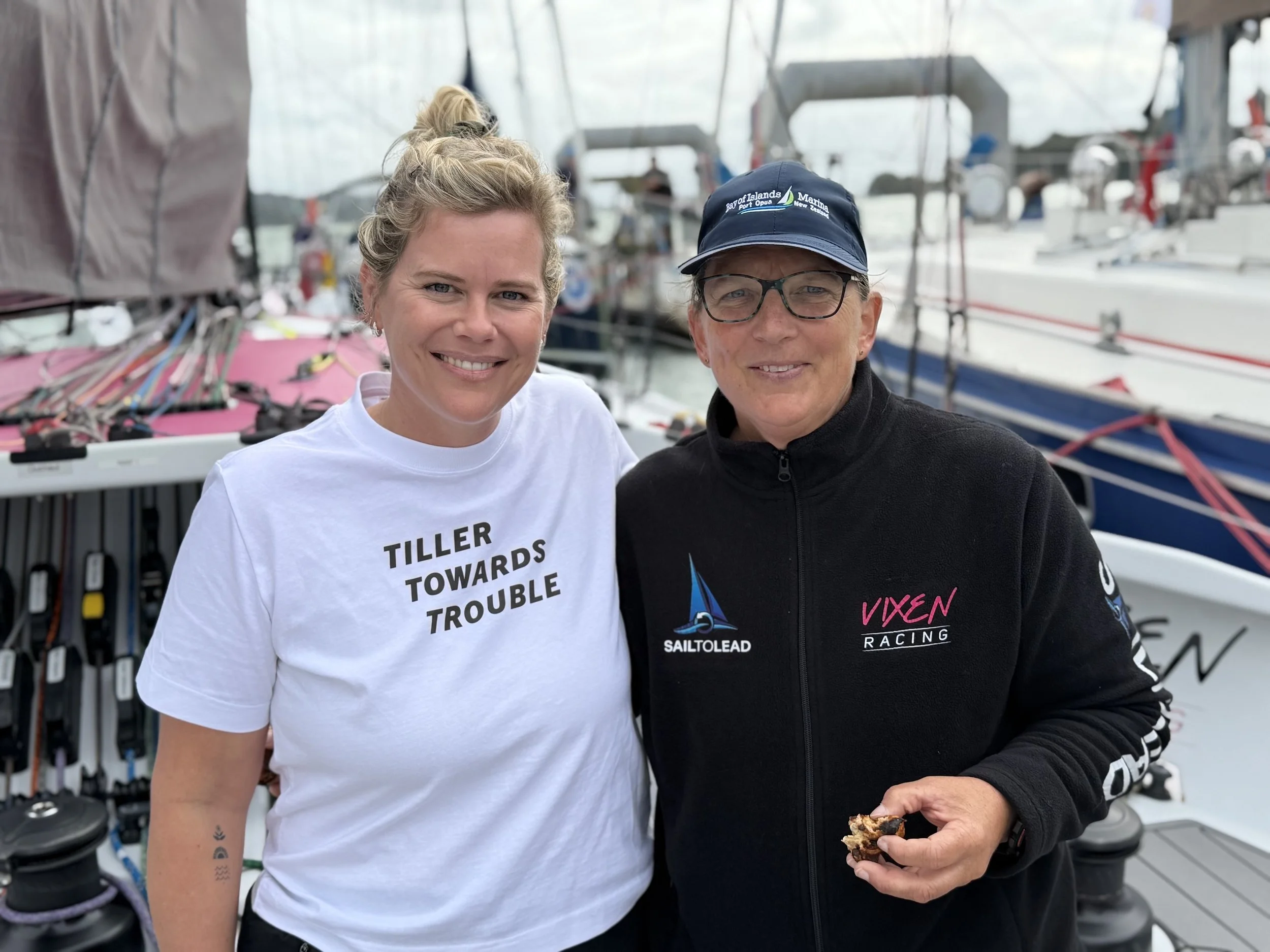
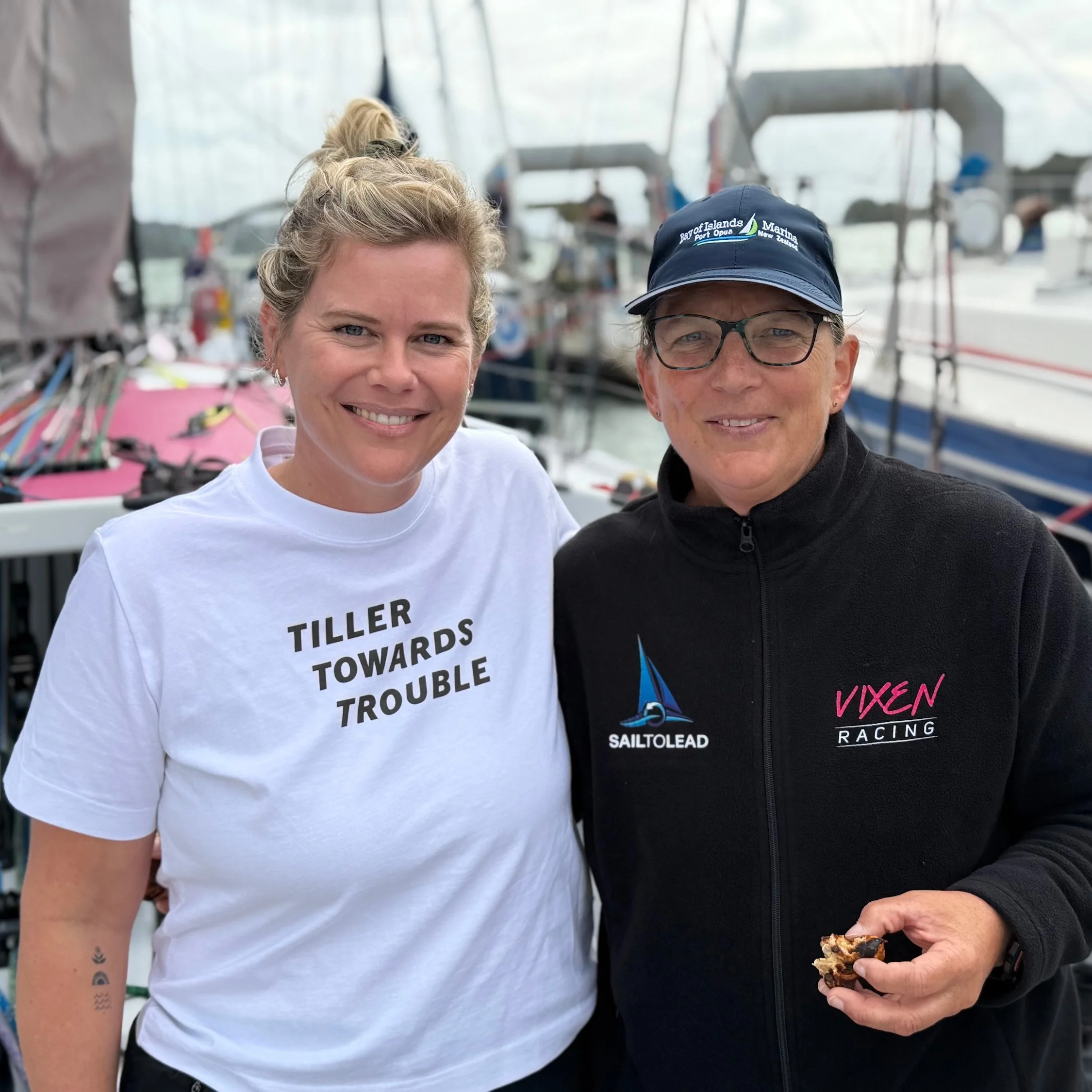
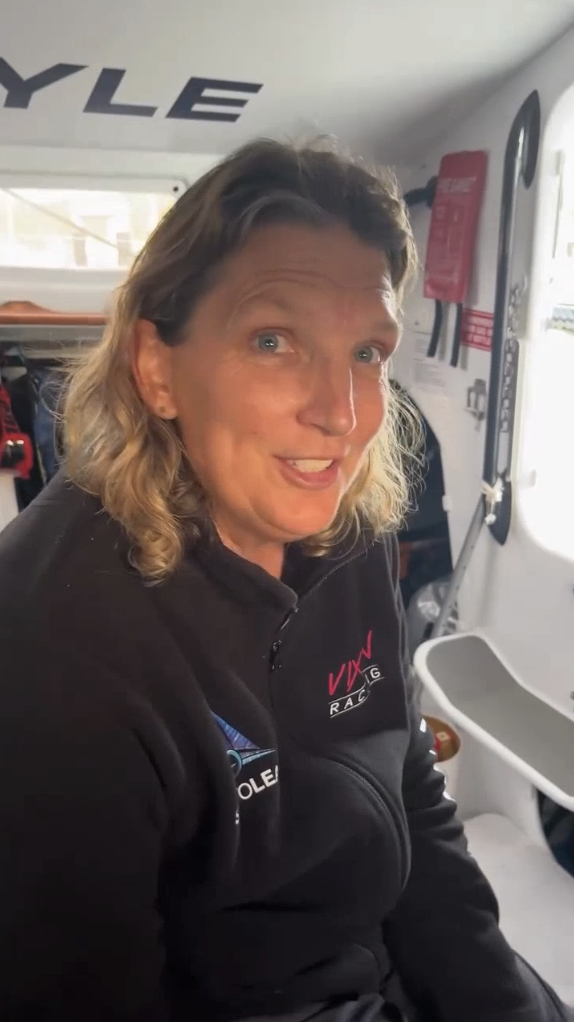
Saltwater Journal Editor Tara Cooney and Sharon Ferris-Choat onboard Vixen Racing at Bay of Islands Marina, New Zealand — ahead of the race start
Saltwater Journal is reader supported.
When you buy through our links we may earn an affiliate commission (at no extra cost to you)
The Solo Trans-Tasman Yacht Challenge is an iconic 1,170 nautical mile offshore passage from New Zealand to Southport on Australia’s Gold Coast, the race pushes sailors into one of the most demanding environments in sailing — alone offshore, with no crew onboard to share watches, troubleshoot gear failures, or strategise. The race started in 1970 and is the second-oldest continuously-run single-handed ocean race in the world.
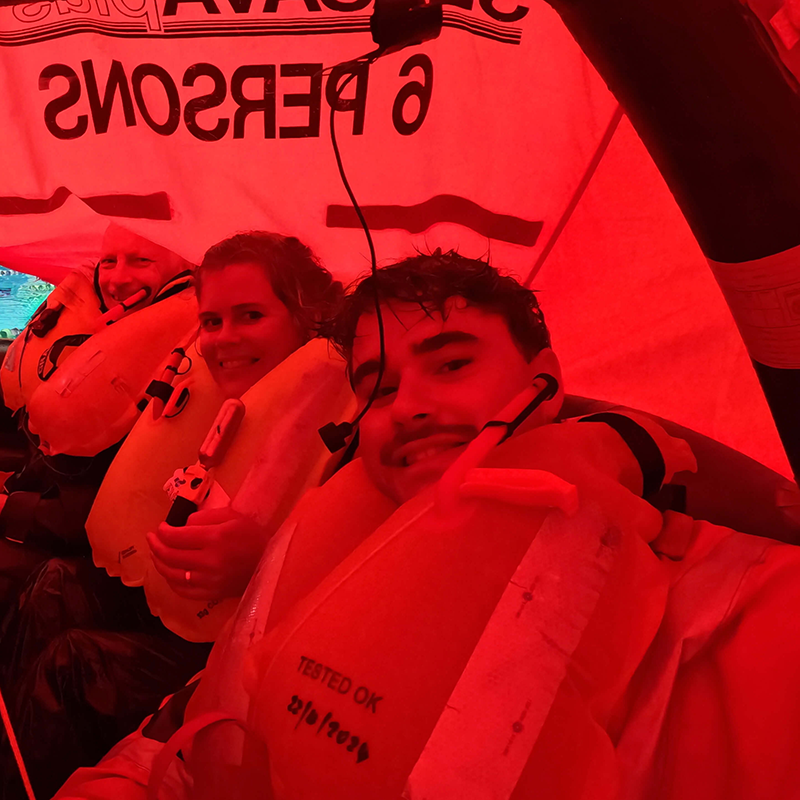
It’s part endurance test, part tactical weather game, and part mental battle against sleep deprivation, isolation, and the constantly changing Tasman Sea. The skippers have all completed their offshore sea survival courses (something all sailors should do).
The 2026 edition sees a fleet of 15 sailors preparing to depart from Opua, in the Bay of Islands, New Zealand with everything from purpose-built offshore race yachts to seasoned cruising boats lining up on the start line. Kiwi sailors have taken out the last two race wins — and there’s plenty of anticipation around whether New Zealand can make it three in a row.
Ahead of the start, I caught up with Sharon Ferris-Choat from Vixen Racing onboard her impressive Verdier Class 40 yacht to talk about what it really takes to race offshore solo.
And Sharon knows the offshore world well.
A two-time Olympian, Volvo Ocean Race sailor, offshore speed record holder, and part of the winning Doha 2005 nonstop circumnavigation team, her sailing career spans everything from Olympic campaigns to some of the toughest offshore racing environments in the world. She was also the first skipper to lead an all-female crew in the Extreme Sailing Series, and today continues mentoring women in offshore sailing through initiatives like the Magenta Project and Vixen Sailing Academy.
From sleep schedules and sail changes, to safety at sea, weather strategy, and the emotional pull of offshore sailing itself — Sharon gives an honest look into the reality of being alone at sea with nobody else onboard to lean on.
With the fleet preparing to leave Opua this weekend, the atmosphere around the marina is electric — support crews making final checks, weather routing conversations in full swing, and sailors mentally preparing for days alone at sea.
Fair winds to the fleet!
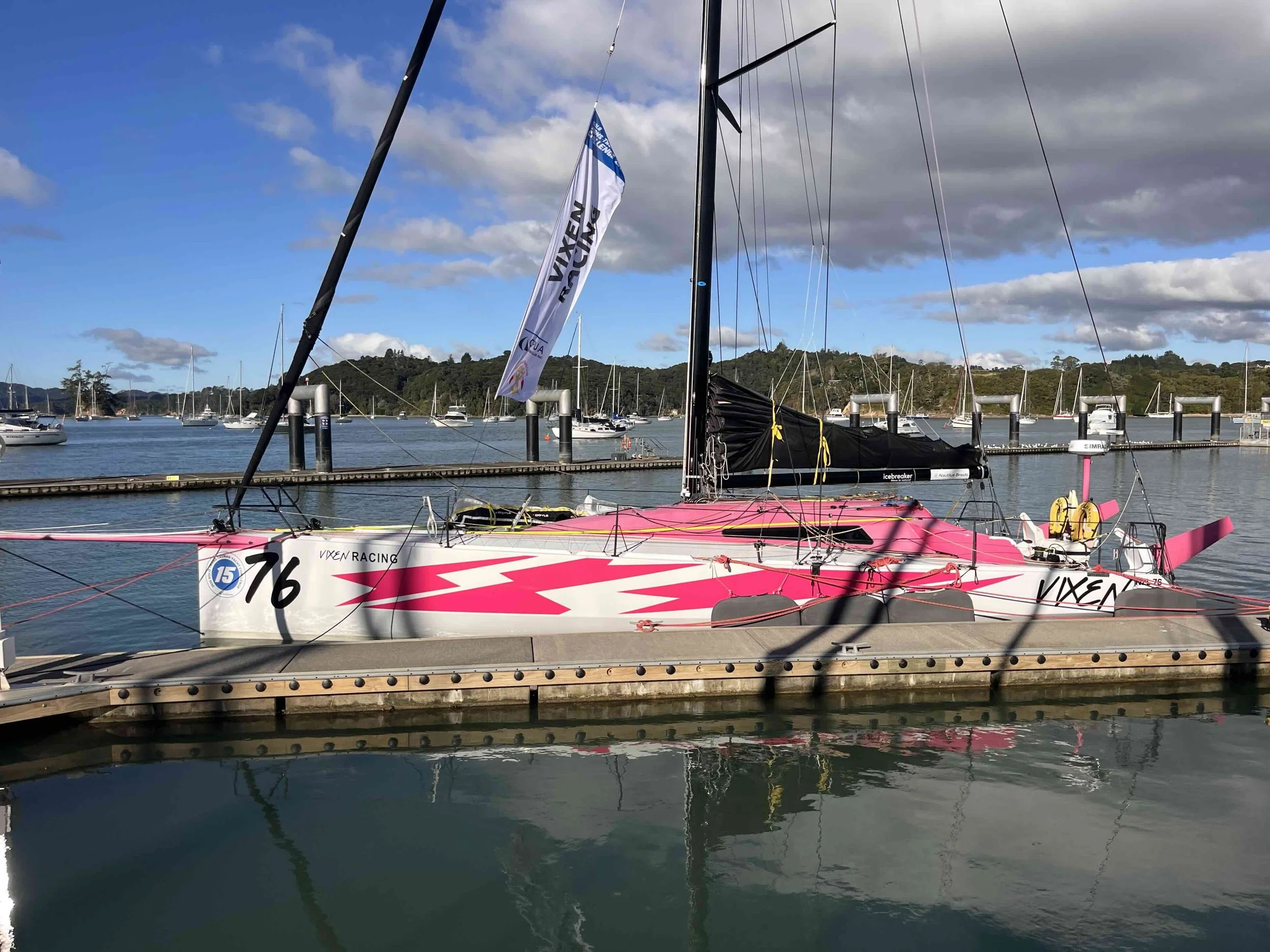
Vixen Racing (Verdier Class 40) prepped and ready to go at Bay of Islands Marina, New Zealand
INTERVIEW BY TARA COONEY WITH SHARON FERRIS-CHOAT | VIXEN RACING
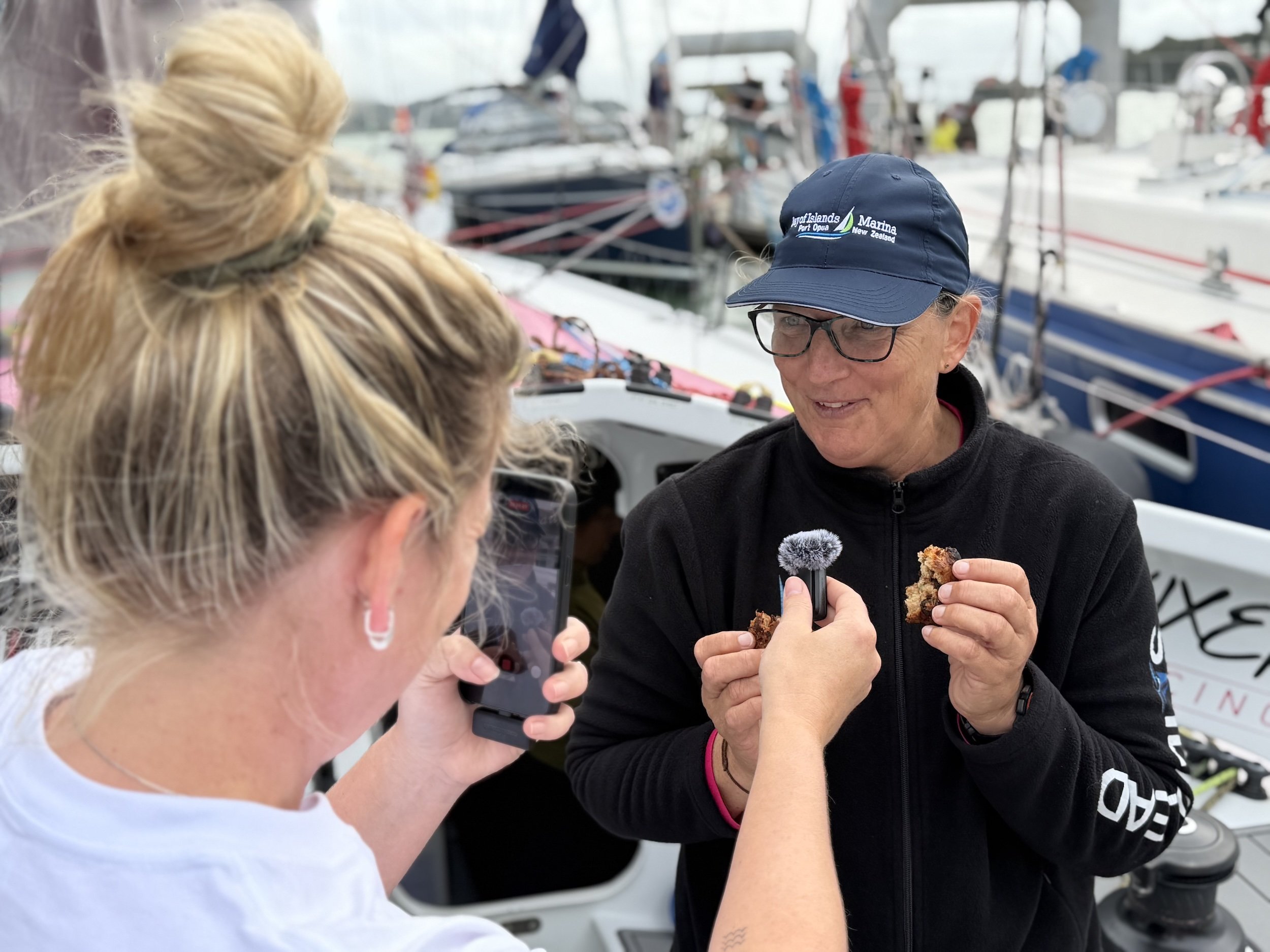
Pre-race yarns aboard Vixen Racing
Tara: How are you feeling about the upcoming race?
Sharon: Well, the weather could be a bit nicer. It’s not quite playing the game.
It's looking gnarly…(4-5m waves, 35-40knots)
Yeah, it is, especially around the top of New Zealand (Cape Reinga).
How do you find your sleep coming up to the race? Do you get anxious or are you able to have a good night's sleep?
It depends. It depends how organized I am. If I can tick everything off that list and not have anything that's worrying me or anything like that, then I can sleep well. And, when I did my last 500 miles by myself, I slept for a week solidly out. So, hopefully that will happen for the next three days too.
How much sleep do you get during the race?
I sleep for a maximum of 20 minutes because that's what I can visually see on the horizon. If a cargo ship's coming or another boat or anything like that, I've got my radar set at that, so I've got time to react if something's coming in.
But I've also got AIS alarms, radar alarms. I've got two kitchen timers that are going off, my phone, and there's multiple alarms going off. And I never sleep when the engine is on because that can just put you into a really deep sleep that can, you know, become dangerous if you don't wake up. So I like to have 20 minutes, and then I come up regardless, and I'm quite lucky that I can just poke my head out of the hatch and just look around and not have to get 100% kitted up and, you know, all the layers, and just poke my head up, scan the horizon, make sure that there's nothing there that's not on AIS because there are fishing boats who shouldn't be there that are there.
And then yeah, if I'm happy, I'll go back to sleep. If not, I'll make the adjustments and then go back to sleep.
And it must help that the bunk's super uncomfortable looking. You don't really wanna lie around…
No. And I've got a wet bunk, and I haven't even bothered making the dry bunk.
I'm saving the dry bunk for Southport (Queensland, Australia) so that I can get into it and be dry when I get there. But no my bunk is...I can get into it in my wet weather gear. If it's really rough, I'll sleep with my life jacket on, ready to go.
Well, in talking about the rough weather, it looks to be, like, four to five meter waves coming around the top of Cape Reinga.
Yeah!
How does Vixen go in the heavy weather? How does she feel on the big waves going at speed? How does she feel under control there?
As long as I've got her balanced, she's perfectly in control. If I don't have her in balance, like for example, have too much main up and not enough jib up, she'll struggle, like any boat does when it's not balanced.
So I'll have to make sure that I monitor that. And what I do is every now and then if…I mean, it's obvious when she's struggling, 'cause she literally goes all over the ocean. I'll jump on the tiller, have a feel, go, "Okay, I need to change this quickly," and then I'll react accordingly and get her balanced, and then she'll be fine again.
And what sails are you carrying on board?
Too many right now (laughs). I need to cull some. Basically I've got the whole range. I've adapted the A-sails to go into a sock. But I'll be talking with Clouds and with Justin over the next 48 hours, and we'll make a call of whether we take them all, 'cause at the moment we certainly don't need them all.
And you wanna try and travel as lightly as possible in this boat. Like, everything seems to be carbon. Your sink's carbon. You've got the one Jetboil for your galley. What else have you sort of sacrificed in terms of keeping her light?
Well, the fridge went today (laughs). I mean, I don't need that fridge.
I'm not gonna be getting into it, that's for sure. And also it draws power, you know? So to save on diesel, to save on power consumption. Yeah that came off, and things like the hose comes off. The vacuum cleaner comes off. We have those things in port for keeping her tidy and clean, but I've just taken them all off.
We will make a call on the sails. I think there's two sails that can come off at the moment, but we'll make that call on Friday. And then I gotta be a little bit careful because we are continuing and racing in Australia, and then we don't want to get to Australia and go racing and go, "Oh, shivers, we really need that sail that I've left behind."
So it's a calculated decision on what we're going to use. But there is one sail in particular that we've had up for the whole of 45 minutes, since we've owned her, since September (2025), and it's just…it's a big sail. Maybe it's not worth taking that sail, you know. 80kg I can get rid of right there.
That's a lot of weight.
Yeah that's a lot of weight! And also, it's a lot of weight to stack and to move, and every time we tack. I mean, we've probably got a ton of gear that we move every time we tack. As soon as you start getting sails in there, it's a lot to move.
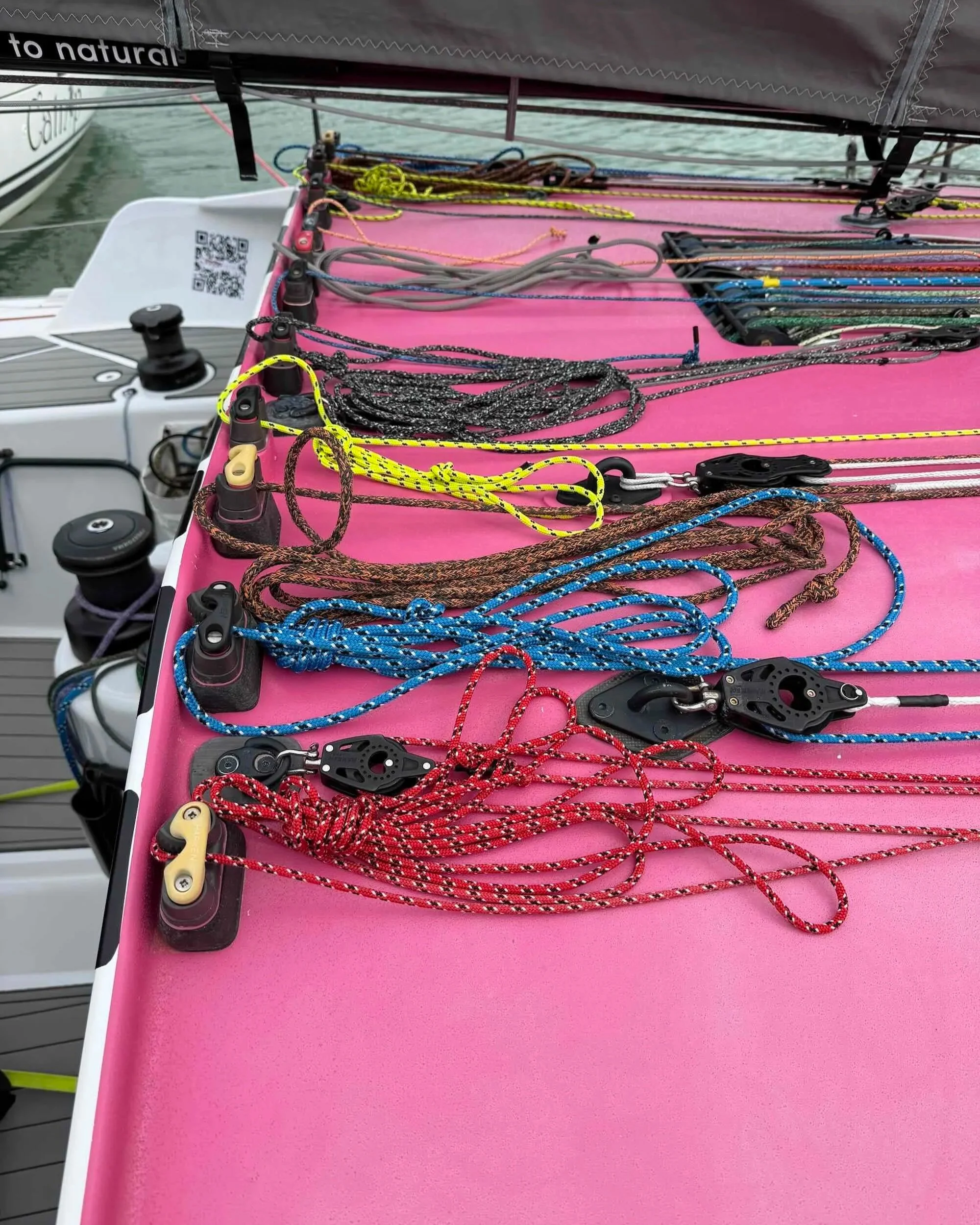
Organised lines onboard
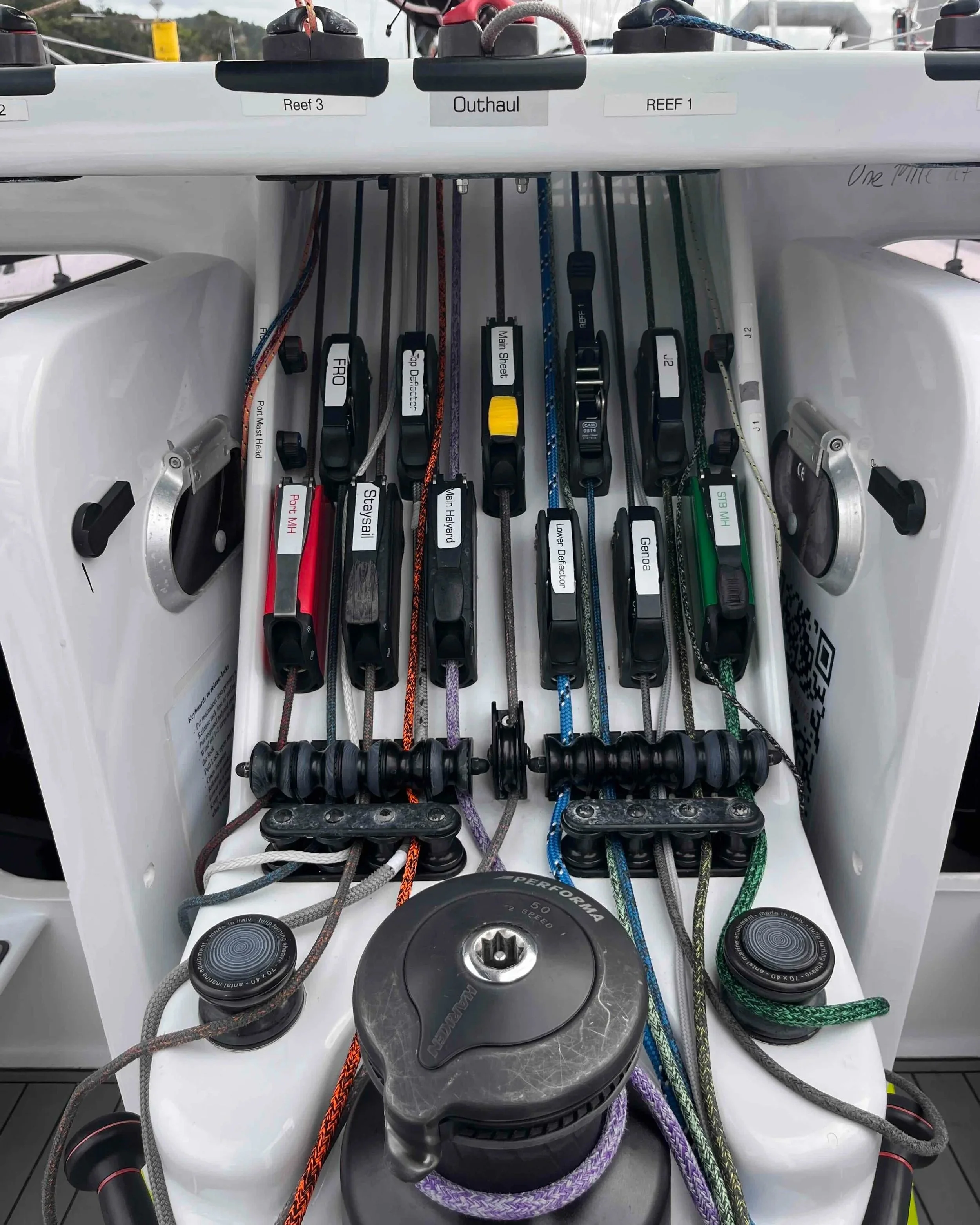
Super organised onboard Vixen Racing
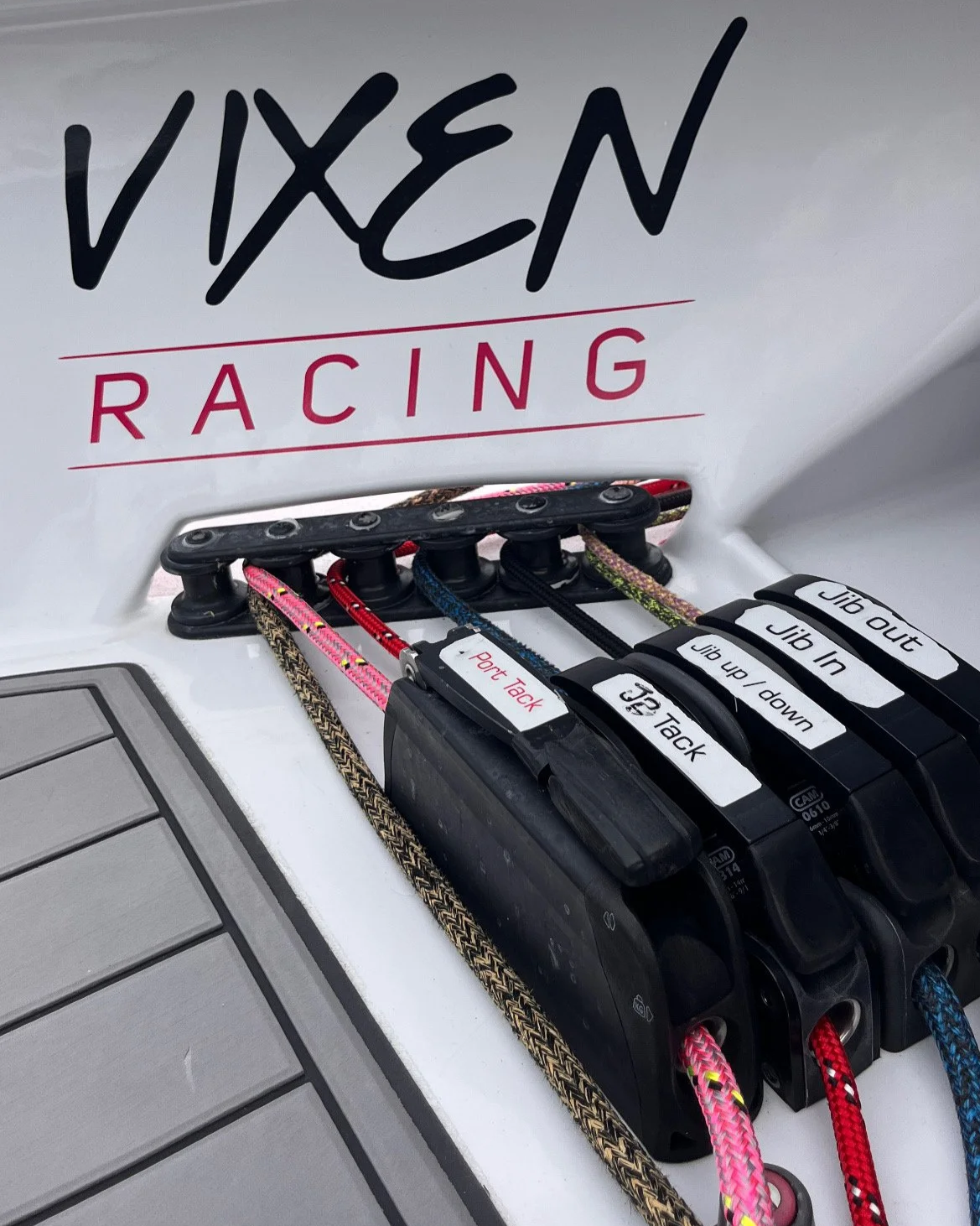
Clutches clearly labelled
How do you manage the changing of the sails on your own? Your clutches and all of your lines are the most organized I've ever seen. What's the technique solo sailing doing your sail changes?
Sequence! It's like playing a game of chess or, you know, or a dance or something. Everything has to be in sequence. And I've got some cheat sheets here that I've made up so that before I do a maneuver, I can just run through it and go, "Oh, yes, I forgot that one in the sequence," or it didn't come to mind. And especially when you're tired and you haven't slept properly. You can just check, mentally check, and just check. But I always try and do things early. My weakest point is that I don't take reefs out or go to bigger sails soon enough.
That's always been my…always been too conservative. So I know that. But for a safety point of view it's not a bad thing.
It's a real balance, isn't it? Between being safe, keeping the boat together, but then also pushing it to get that speed and to be competitive.
Absolutely. And, also when to push and when to step back. Seamanship becomes a critical factor in finishing. There's no point in not having any sails left because you've flogged them all to bits and not been able to finish. That doesn't work. That's where I've been very lucky to sail with some incredible people. And that's the biggest thing they've taught me is seamanship and getting the boat to the other end.
How much of a successful race comes down to the boat, and how much comes down to the skipper and that seamanship? Obviously you need both for the perfect race. But what are your thoughts around having the right boat, like Vixen, and having experience as a skipper that you bring to the race?
Well, I think preparation of any event, anything that anyone does in life is, is the result is, is probably 70 to 80% in your preparation. Before you even get to the start line. Are you fit? Do you have everything? Is your checklist done? Is your maintenance all done? Have you got backup for the backups. Or have you left something that if it breaks you can't replace, and it's a showstopper? It's about scaling that to what is gonna prevent you from finishing, and what can you make up to get you to the finish line, and do you have everything on board to, to cover that? And that's where I think Kiwis are pretty resourceful. That number eight wire, you know, they can turn into anything. And I don't have number eight wire on board, but I've got the next best thing, which is duct tape.
Has there been anything interesting that you've had to fix, that you've really had to think on your feet during a race?
Well, I've had to repair, battens, boat build on boats, and I've had to sew sails back together again.
There's been a few things. I haven't been in charge of electronics or anything to do with the engine before, but today I learned how to reinstall an alternator if that should fail. There we go. So it's slowly learning.
Yeah. Excellent. And you mentioned the tiller earlier. Vixen has a tiller with dual rudders.
Yeah twin rudders.
Obviously it's a monohull, but it does have the twin rudder set up. Why is it a tiller and not a wheel?
Space. Simple space. The cockpit is already small enough and congested enough. The tiller takes up less space than a wheel.
I quite like the tiller. I am Team Tiller.
Yeah. (laughs) I'm Team…depending on how big the boat is…a wheel definitely has its place on big boats. It's a better feel. It's easier to learn, 'cause the tiller is kinda opposite to what you think. But on small boats it's no-brainer tiller for space.
And talking about speed, how quick does this boat go? And what's your favorite sort of point of sail to get that speed going?
Well, anywhere between 90 to probably 120 true wind angle she just lights up. Yeah. Eight knots of wind and we're planing. So, she's just incredible in those conditions.
Dead downwind, VMG downwind, if it's light she just sits and oh, we do not like that. We do not like the light with this big bottom on her. But she's, she's pretty powerful, so in five knots of wind we can be doing four and a half knots of boat speed upwind. So that's pretty cool.
That's fantastic!
Yeah!
And do you wanna talk me through anything downstairs that I think people might wanna have a look at? 'Cause she's a tight little space.
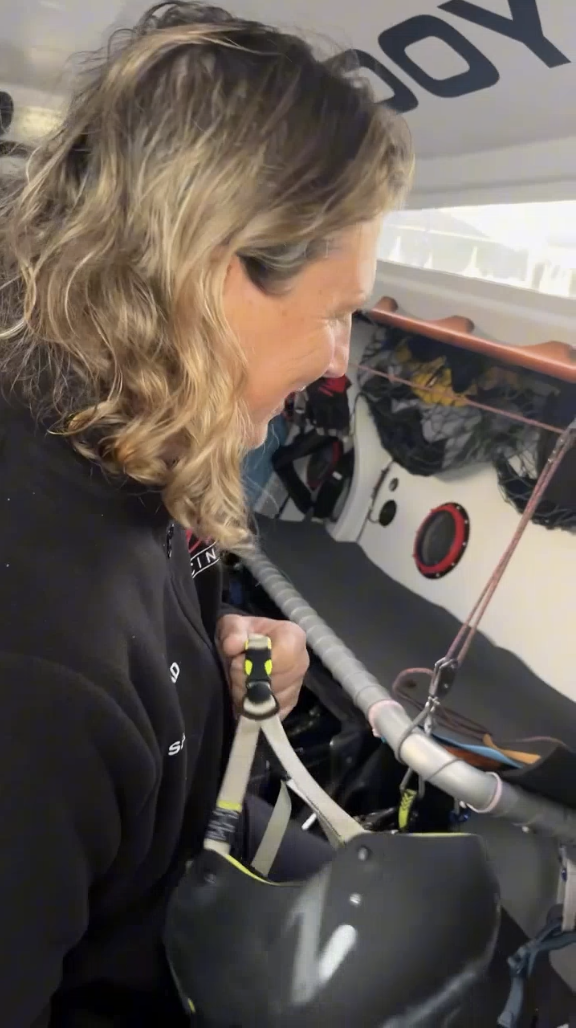
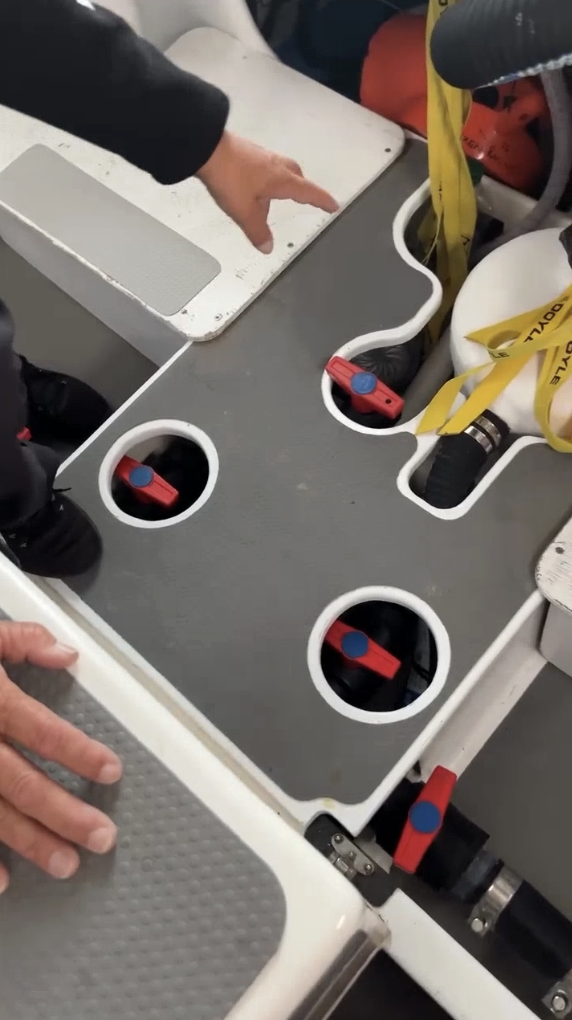

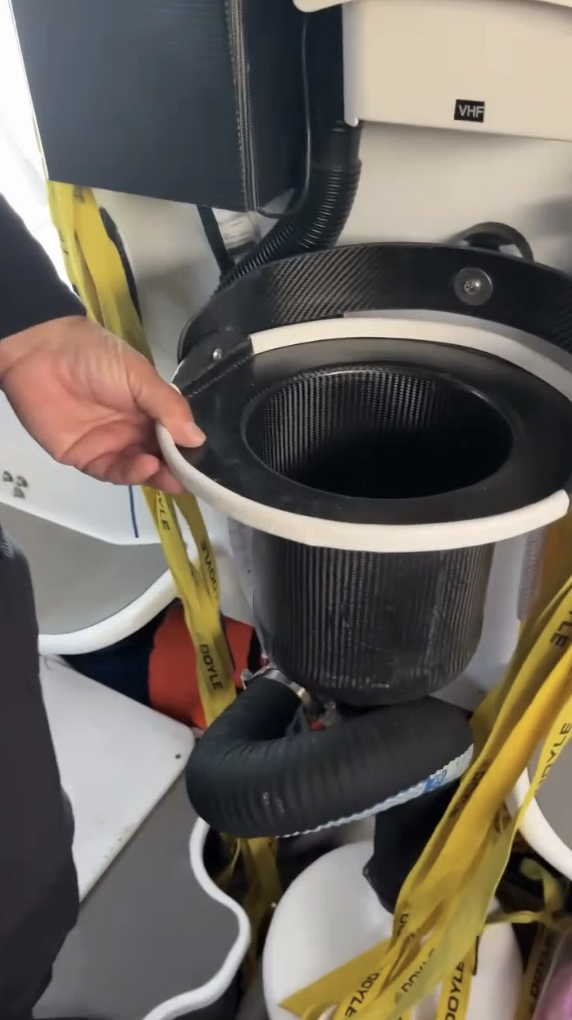
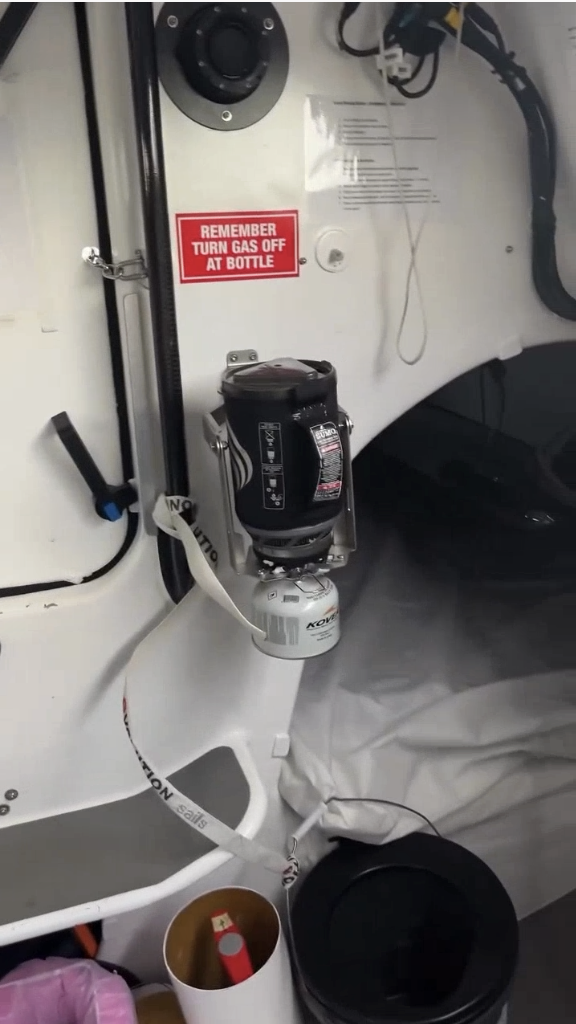
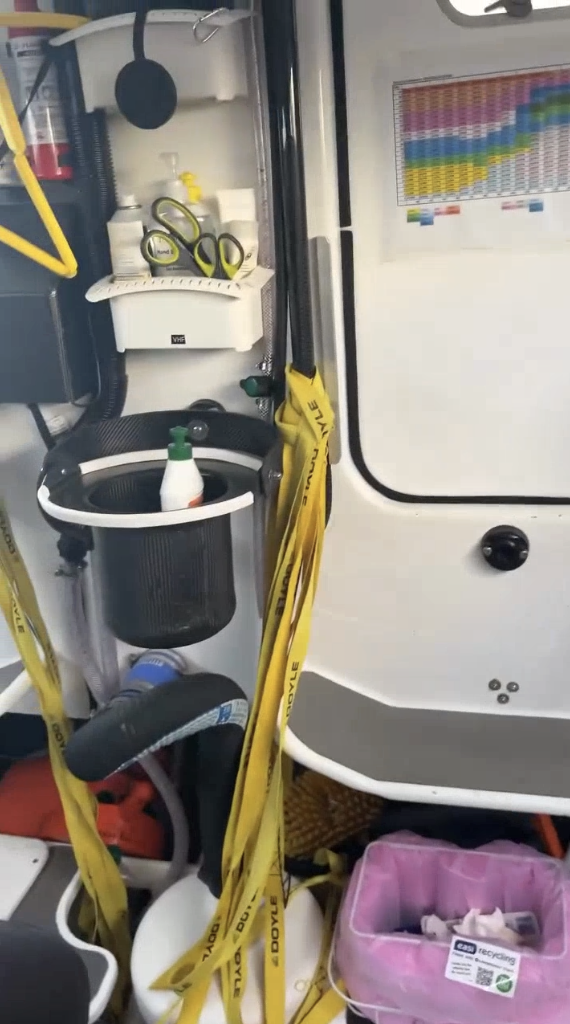
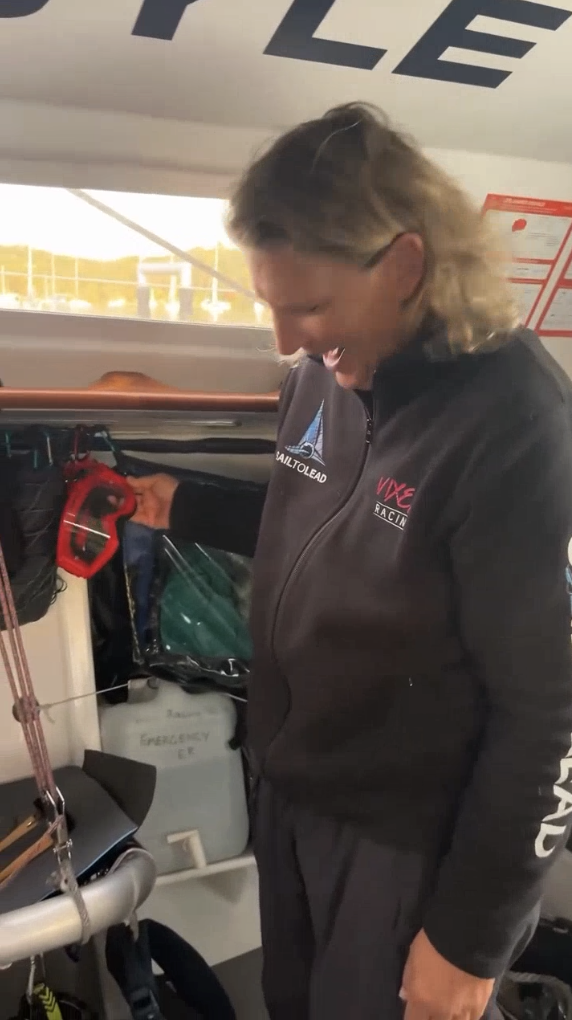
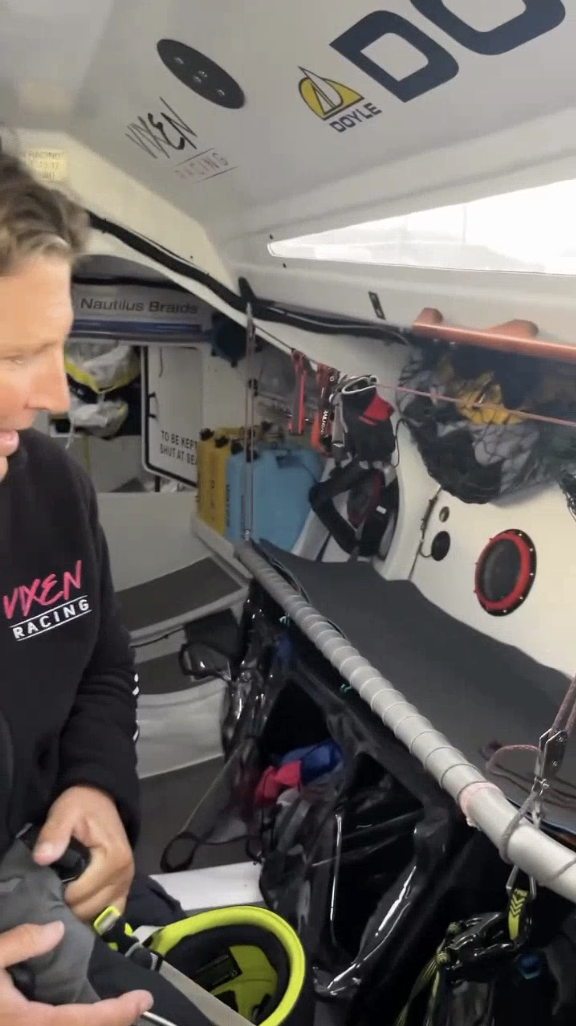
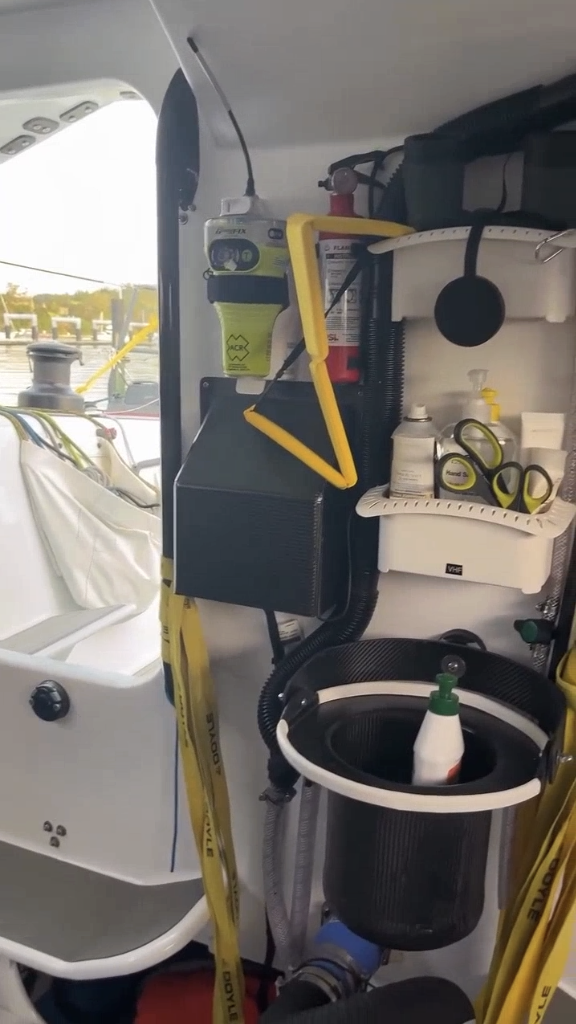
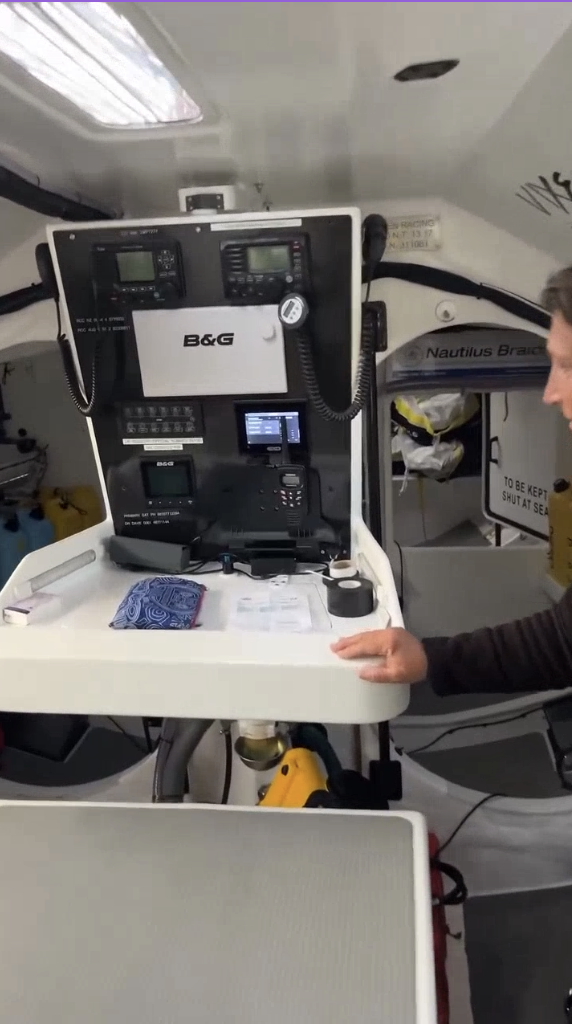
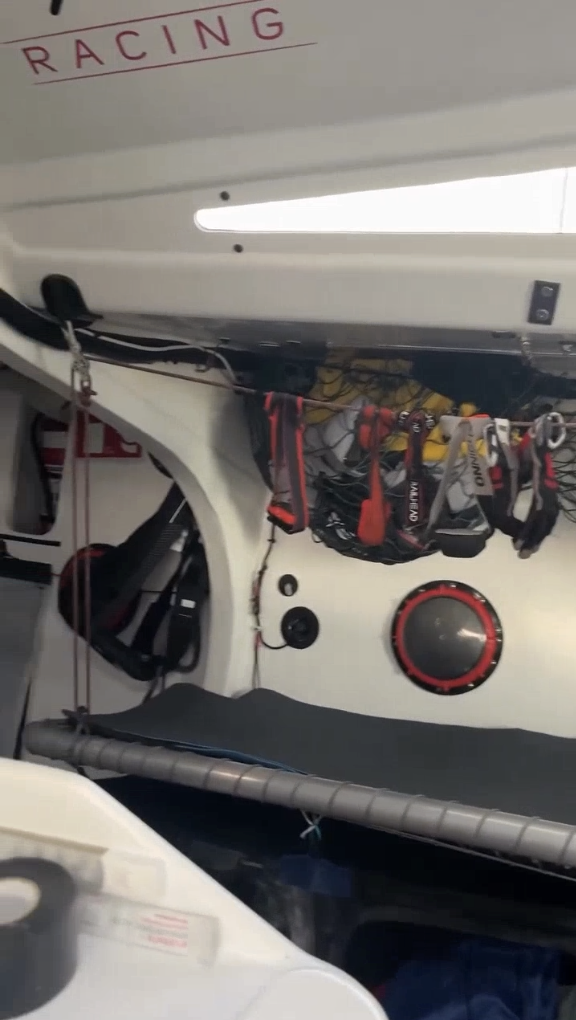
Yes. Well the first thing is the helmet got pulled out today because of the weather forecast around New Zealand.
Yeah, it's looking pretty bouncy.
Yeah. So the helmet did live in the bow, but now it's gonna live here right beside my life jacket. So I basically have life jackets one on each side so that I can quickly get in and out of the twin hatches. This is our nav station. This is my bunk. This is my wet bunk. This is where I can jump into and watch the screen at the same time.
And all the alarms and everything are up there as well. We've got water and diesel. Our engine is under here - underneath this nav seat box.
This is the galley...(the Jet Boil)
This is the galley. The entire galley. But look at this, look at this flash carbon sink
Carbon sink. How good is that?
Yeah. And it's got the cable tie all ready for the main halyard to go on before that goes up on Saturday morning. Terrific. It's just sitting there.
What backcountry meals are we cooking?
Well freeze dried food? We've got a little donation coming in from Radix as well.
Very nutritious, Radix!
Yes!
And what are we using for (toilet)…bucket and chuck-it?
Well, this is the most practical way to go to the bathroom. It’s our best investment ever on Vixen Racing is the $39 bucket.
Absolutely. With a very comfortable lid I have to say — you're not sitting on the rim so that’s comfy…
And the lid's gone being solo. We do have a head up in the bow but in some conditions, you just wouldn't.
No. No. Absolutely not.
We're water ballast. So basically, we have snorkels here that we push down. And then we can suck the water in. There's a pump. And over on each side, we've got 750 liters of water that we can put in to help stabilize the boat and get the righting moment and power. Yeah. And we can charge on and we can hold the bigger sails for longer.
So yeah, it's really good.
Just got that balance right? With the right ballast…
Yeah, yeah.
Keep that speed up…
Yeah, and we can monitor it, like, we're not 100% all the time, but generally after eight knots, we start putting it in if we're going upwind. But obviously if we're going downwind, we don't want it, 'cause we wanna be as light as possible.
Yeah. EPIRB, binoculars, fire extinguishers. We've got the Cape Reinga goggles.
You'll probably need those, I suspect.
Well, if it's gnarly, yeah. Just to save your eyes, you know. 'Cause it's gonna be the first night, and you don't want stinging eyes.
Fortunately, you've got a little bit of moon (to see by) by the looks..
We do. Yeah. That just means you see them coming (laughs).
What is it like when you're out there on your own on the ocean?
It's humbling, 'cause you become so small, and it's freedom. You are in charge of you and your boat, and your biggest competitor is Mother Nature. And if you can read her and interpret her and use her to your advantage, then it's like a sensation.
It's adrenaline. It's natural adrenaline. It's a natural high. It's rewarding. It's all those awesome positive things and then when you get it wrong, you know.
She tells you pretty quickly.
Very quickly, and you gotta get yourself out of that really quickly!
So I know your family's gonna be cheering you on…how old are your kids, Sharon?
So, Sophia's 17, and Victoria's 13.
And do they give you any words of advice, of encouragement?
They're more in charge of the Spotify playlist!
Oh, excellent! So they're setting you up with one? Awesome! What are they gonna put on there? What are the bangers?!
Oh, I've asked them for, for high energy, '80s kind of music, but it's really cool 'cause that's what they're into too, to a point, so it's really awesome!
That's a really nice way to have them with you, to have them curating some music for you.
Yes, yes, and I'm like, "Yeah, like that one. Oh, no, that can go," you know? But they, but normally they're spot on. They know what I like.
I wish you all the best Sharon!
Thank you!
We're all going to be following the tracker and following everyone, but I think with you being one of the top sailors, to be honest, I think you’re gonna be right up there. So, so excited to see you make the finish line and do really well.
Just before we go, Sharon, who's your biggest competitor, do you reckon?
All of them. I'm not writing anyone off. Anyone can have their day out there in the Tasman, and yeah, I'll be watching all of them to see where they're going, and I just wish everybody all the best.
Excellent. That was very diplomatic. But I think you're right. We'll have to wait and see who pulls it off, but hopefully it's a Kiwi for the third time in a row. We’ll keep that Trans-Tasman rivalry going, eh?
Oh, absolutely. We've gotta sock it to the Aussies! Come on!
Woo-hoo!
- INTERVIEW ENDS
If you’re keen to race on Vixen Racing — check out the Vixen Racing Academy for opportunities to learn everything you need to know about coastal and offshore racing.
Did you enjoy this article? Share it online and read more on the Journal…